

SEEING BLUE-GREEN AGAIN
The shape of the mountain moves step by step, and the mountain is viewed from all sides, and the tops of the mountains are so different. Especially so, so it is a “huge shape”.
Hong Bo’s Art
Development from Writing to Collage
& Installation
Hong Bo’s artistic development and recent works surprised me.
In Hong Bo’s previous ink paintings, achievements, and characteristics of a Chinese ink painter in the United States are shown. He uses the feeling of “rivers low, mountains high, the same moon in the sky 山川異域、风月同天” expressed by Chinese water ink, letting people know that the expressive power of water ink is beyond expectation. The mountains and rivers of the United States and the unique natural scenery of the San Francisco area are seen through Hong Bo’s works, through the conversion of brush-ink, and retain the Chinese charm in the language of brush and ink and the particularity of the exotic mountains and rivers. This may have the same meaning as “the region has changed, the brushstroke cannot remain 思想变了,笔墨不能不变” and if you change your mind, you must change your brush-ink. What he is trying to do is explore and pursue the relationship between Chinese ink painting and regions; in terms of brush-ink expression related to the development of traditional ink painting, inheritance and development are more about showing his ink painting in the reform and the modernity of ink. Therefore, the expression of modernity has become a unique force in his artistic pursuit, promoting his artistic creation, work, and artistic development, including the transformation of art.
However, in Hong Bo’s recent works, there are new styles that are different from the past. His collages and installations are surprising, but also let people feel a kind of freshness when they are surprised; obviously, this has gone beyond the category of ink painting. Hong Bo’s turn may be the “dancing of hands and dancing of feet” after “sufficiency of singing”. In order to solve the deficiencies in art, such a way of unscrupulous dancing is actually a new perspective. In his mind, he presents a new direction of development, which in turn is based on the images he has created in the past. This can also be seen as Hong Bo’s re-start in stages. In the way of visual images constructed by collage, people can still see Hong Bo’s past brush and ink colors and can still see the background of the kind of picture associated with the past. In his collages, the textures and interrelationships of the materials are not a kind of free imagining, but a new landscape construction entangled with the past; therefore, the concepts and methods show in his works that the transformation of the style has changed from painting to a kind of production. These are two very contradictory aspects, because in terms of painting his ink paintings cannot be reconciled to writing directly from the heart due to making a general identification with the dissolution of writing. It comes from the aversion to production of traditional Chinese literati paintings, which are scoffed at by literati art, so this is an irreconcilable contradiction of two aspects. However, collage and constructing in modern art are commonplace, becoming a language of modern diversity and aesthetic content. This is just like the ancient seal cutting with a knife instead of a pen, but the way of expressing is different when the tool material is changed; they are a communion. What Hong Bo’s collage works show is imagination inspired by using different materials. He seems to be tired of the plane and wants to be on the water wrinkles that can be seen in the ink, and these wrinkles lead to the texture of the landscape that he is familiar with, which is a way of writing conversion. There are innumerable connections among them. At this time, the writing method of the Xuan paper itself has been separated, although there are still colors in it. The change of color has the relationship between black and white, as well as the density and layout, and the internal connection presented by the medium and texture. Similarly, in the law of formal beauty, such a collage still allows people to see the special content in the formal language. Through the special content, people seem to be able to see some connection with nature; of course, this is an aesthetic imagination. Although through this aesthetic imagination may transcend the painting itself, it is still a kind of beauty conveyed by his works to people. In Hong Bo’s installation works, he tries to construct those specific contents connected with his landscapes, and these specific contents may be of a kind that is different from the new landscape in the past. This is a plausible landscape made entirely through collage, which may also be from some of the landscapes he painted himself. This partial magnification is the development of collage art. What this art form shows is that he is no longer satisfied with the two-dimensional expression on paper-the “five-color-ink" and “vivid charm” . For such a pursuit, happening at the same time, what is shown is Hong Bo’s pursuit of new artistic language and methods, or perhaps he is dissatisfied with the old ones- the traditional way of writing-‘I hope to use a new way to construct the landscape in my heart.’ However, he is not satisfied with collage, let alone dabbling in it. He wanted to extend his grasp of green, and he used the display of the installation to expand his field of vision so that people could see this step-by-step process of change. In Hong Bo’s installation works, what people see is the development of the traditional Chinese green landscape, which can also be seen as a relationship with his writing method. Hong Bo just transformed the brush-ink structure of writing into a structural relationship in the installation. This structural relationship is not flat, but three dimensional, so his installation is like a green landscape sculpture, with specific content such as overlapping peaks and peaks and scattered heights, including the construction method and style, and this installation art has become a supplement to his landscape paintings. Interestingly, he took those with the relatively independent blue-green landscape installations and combined them in different ways to form a new visual system. It reflects a principle of building blocks, a kind of ever changing green, although there is a relationship between each unit and the whole. However, the independence of the unit still has independent aesthetic significance and can still be regarded as an independent work. This is the development from collage to installation. China’s Green Landscape is a unique cultural symbol different from ink and wash, and the azurite, stone green, ocher, etc. it contains are also a symbolic identity. The meaning of such an installation by Hong Bo to his landscape is a dialogue between the past and the present, and the art installation is a dialogue with the traditional ink painting, which uses blue-green to interpret the five colors of ink. The cultural significance expressed in such a dialogue, both that there are contradictions and oppositions in cultural inheritance as well as inheritance and development in cultural traditions, at the core still expands the category of landscape to develop its expressive and aesthetic significance. Therefore, when these works are presented in one exhibition hall, or in different spaces sometimes, what is presented is another special relationship between space and structure, which is different from writing installation art, which is far away from painting and close to the installation of sculpture. Hong Bo’s profound thinking and artistic expression has surpassed the performance of ordinary landscape painters and surpassed the past brush-ink expression. The enlightenment he gave me is that an artist always works hard on brush and ink or develops a multi-channel effort and multidirectional development to construct a new landscape expression from all directions or from different angles. Hong Bo's Green Landscape Installation Art is a manifestation of a new landscape. Whether it is a collage or an installation, or even pen and ink on paper, it shows some of the various possibilities for Chinese landscape painting in the development process of the 21st century. Hong Bo expresses through these landscape paintings, collages, and installation art ‘now, let people see the vitality of Chinese culture in the development of modern society; he makes people think about some changes in the process of cultural inheritance. The difference may be to enrich the ontology, or it may be to enrich the contemporary connotation of Chinese landscape painting and many new contents of contemporary development. Hong Bo has given us new works and new developments that make people’s eyes shine. Therefore, the surprise he gave me may be exactly what I expected while waiting for his newest developments.
- Chen Lvsheng
Art Historian Former Deputy Curator of National Museum of China

The combined pictures of No. 2, 3, and 4 of Seeing Blue-Green Again (view 2)
Installation Art / Color, Ink, Xuan paper, Foam, Comprehensive materials. 240cm×400cm×260cm 2022
Seeing Blue-Green Again No. 1 (view1&2)
Installation Art / Color, Ink, Xuan paper, Foam, Comprehensive materials. 240cm×400cm×260cm 2022


Seeing Blue-Green Again No. 1 (view3&4)
Installation Art / Color, Ink, Xuan paper, Foam, Comprehensive materials. 240cm×400cm×260cm 2022

Seeing Blue-Green Again No. 1 (detail)
240cm×400cm×260cm 2022

Seeing Blue-Green Again No. 1 (detail)
240cm×400cm×260cm 2022

Seeing Blue-Green Again No. 1 (detail)
240cm×400cm×260cm 2022

Seeing Blue-Green Again No. 1 (detail)
240cm×400cm×260cm 2022
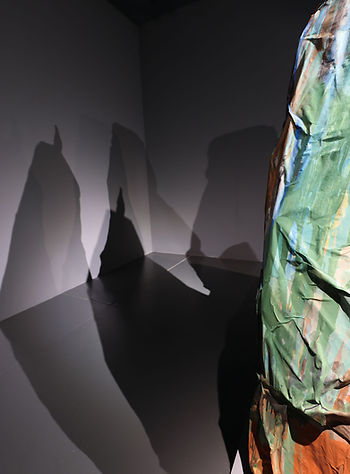
Seeing Blue-Green Again No. 1 (detail)
240cm×400cm×260cm 2022

Seeing Blue-Green Again No. 1 (detail)
240cm×400cm×260cm 2022

Seeing Blue-Green Again No. 3 (view2)
50cm×50cm×50cm 2022

Seeing Blue-Green Again No. 3 (view1) 50cm×50cm×50cm 2022

Seeing Blue-Green Again No. 2 (view2)
50cm×54cm×66cm 2022

Seeing Blue-Green Again No. 4 (view 1)
Installation Art / Color, Ink, Xuan paper, Foam, Comprehensive materials. 140cm×90cm×90cm 2022
See Mountain is Mountain:
Interpretation of Hong Bo’s Series of Seeing Blue-Green Again
Blue-Green—Oriental Imagery Blue-Green has a special direction in the context of Chinese painting. A color developed from the mineral pigments from azurite (blue) and malachite (green) with the luster of gemstones, it contains the aesthetic image of prosperity and infinite vitality and is used in landscape paintings, to evoke the stability of world peace and a solid country. From Dunhuang frescoes to silk scrolls, Stroll About in Spring (《游春图》) to A Thousand Li of Rivers and Mountains (《千里江山图》), Blue- Green is an artistic treasure of Chinese traditional painting and representative of oriental aesthetic imagery. Green—The Color of Healing In the traditional Chinese cultural system, the five colors correspond to the five directions, and the east is green (Shuo Wen Jie Zi 《说文解字》: green, the color of the East. 青,東方色也). Green symbolizes that everything grows, and the earth rejuvenates. In the rhythm and reincarnation of nature, green branches and green leaves, green mountains and green waters can always bring spiritual comfort to people. “Green” is a unique spiritual landscape for Chinese people. Hong Bo (Direct transcription from the interview): “Anti-epidemic practices have entered the third year, closure and isolation have become the norm; the world economy has been generally affected. Pause and depression linger, and people’s minds are covered with a shadow. At this time, I am thinking: What can artists do? In the face of anxiety and bewilderment, traditional culture is awakened again, and the dance “Only Blue-Green” relies on the creative interpretation of the famous blue-green landscape work A Thousand Li of Rivers and Mountains (《千里江山图》). It is popular across the country. Green has become the most healing color, bringing painters new revelation.”
- Qin Jiming
Art Critic, Calligrapher, Painter


* Visit us by appointment only
CHINA
+86 13428724452
+86 13229760082


抖音

微信视频号

小红书