

FRAGRANCE FROM TRUE COLOR
Breed a color of life, activate, deconstruct, transform, and gain the understanding of power and energy.
Interchange: Flowers Fall
Beyond the
Edge of the Sky
Synthesizing the fluidity and materiality associated with Chinese Ink Art and the spontaneous immediacy of Abstract Expressionism, Hongbo has created a masterwork that resonates within both cultural traditions. Ink Art has the longest history of any visual art produced by any culture. Its artistic output is matched with an equally prolific scholarship that has accumulated over the centuries into a deeply nuanced constellation of ideas that are re-consumed by each successive generational wave of artist. As wider understanding of Ink Art has entered western critical consciousness attendant to art, and the contemporary attitudes that characterize art in the west gain influence among Chinese Artists, the central question produced within scholarship pertaining to Ink Art asks how a contemporary artist operating in this medium may critically progress it, given its tradition heavy narrative?
Hongbo maintains studios in Los Angeles and Shenzhen, traveling frequently between them. He is enabled to imagine a culture that does not exist anywhere, that is without a territory, that is sensory and experiential nonetheless. It is a dream space. His cultural space is thus a floating ontological world that he has manifested into a uniquely authentic practice. What is known, and what is immediately experienced enables a spontaneity that we witness through his handling of materials that within themselves are ‘informed’ and without habituation. Ink is a medium that is boundless, it is amorphous and unpredictable. Hongbo’s process is immediate and energized. It is not only an interplay of cultural subjectivities, but also a legitimate liberation of a tradition through his skillful and innovative removal of the constraints of a medium. Interchange: Flowers Fall beyond the Edge of the Sky is the most powerful work produced by one of the leaders of contemporary Chinese Ink Art. It is endowed with a pure beauty that is universal and that is not culturally specific nor dependent upon context. The vertical panels align to create a horizontal metaphysical vista that open the viewer to an amorphous and organic experience that is suggestive of a nebula-a coming to form, as opposed to a predetermined formal organization. Hongbo provides us with a viewing of a space that is relieved of rational limitation, the fluidity of Ink and the absorbent qualities of the ground produce a soaking effect that evoke an aesthetic equivalent of the quantum, somehow capturing the rhizomic distributional nature of our universe. Hongbo has produced a work that is in and of itself-and in so doing presented a universal patterning of energy accumulations and flows. Any form of tradition or system of historic organization is subsumed by a greater universe, that being the inter-relationship of action, resistance and matter. Interchange: Flowers Fall beyond the Edge of the Sky is a work that offers us a tangible configuration of the underlying energies that form our reality. It is pure and potent abstraction, a window onto the morphogenic space that is simultaneously inherent to us and the world around us.
- Richard Wearn
Professor of University of California, Los Angeles
Shining
Lotus Light
In traditional Chinese culture, lotus has always been a symbol of a gentleman’s character and noble morality. Hong Bo lives overseas, and his heart is attached to the motherland. He often paints lotus flowers in colorful ink to cover the shadows of the lake and water, and deduces the taste of the lotus in his hometown that spans time and space. The colorful ink lotus did not abide by the traditional ink lotus painting method, but infused the western modern expressionist style and visual composition consciousness into the picture, forming a painting with huge brushstrokes, a huge color gamut, and both form division and deformation expression.The artistic language strengthens the visual tension and the contrast of warm and cold colors, just like a symphony of colors reflected by light and shadow. In such a situation, these colorful ink lotuses have also stepped out of the moral pattern of oriental Confucian culture, and are endowed with another full and splendid vitality and appeal. Undoubtedly, these lives rooted in the natural world also contain universal aesthetic spirit and ethical connotation.
- Yu Yang
Professor of Central Academy of Fine Arts, Art Critic
The Triple Screen of Blossoms Falling to the Horizon
Ink and color on paper 367cm×144cm×3 2021


The Triple Screen of Blossoms Falling to the Horizon (detail)
Ink and color on paper 367cm×144cm×3 2021

The Triple Screen of Blossoms Falling to the Horizon (detail)
Ink and color on paper 367cm×144cm×3 2021
Fragrance
Ink and color on paper 69cm×36cm 2018


Aroma and Brightness
Ink and color on paper 178cm×96cm 2021
Moonlight in the Lotus Pond
Ink on paper 180cm×97cm 2019

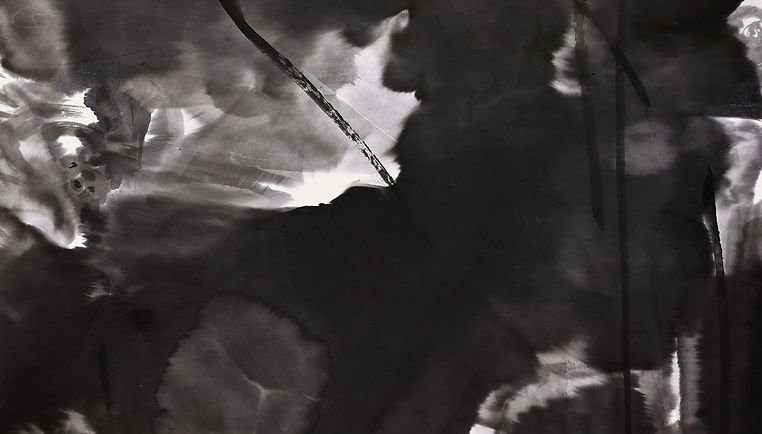
Moonlight in the Lotus Pond (detail)
Ink on paper 180cm×97cm 2019

Moonlight in the Lotus Pond II
Ink on paper 125cm×125cm 2021

Lake Full of Green Clouds
Ink and color on paper 180cm×97cm 2021
Lake Full of Green Clouds
Ink and color on paper 145cm×160cm 2021


Lake Full of Green Clouds (detail)
Ink and color on paper 145cm×160cm 2021
Writing Lotus Flowers by Brushstroke
and Color:
The Lotus Art of Accumulating Colors by Hong Bo
Chinese people have a special affection for lotus. Lotus is known by its scientific name Nelumbo nucifera, also called Nelumbo nucifera Gaertn. In the eyes of Confucianists, the lotus emerges from the mud but is not stained, and it is a symbol of a gentleman’s character. The relationship between Buddhism and lotus is deeper, and there are almost no lotuses in the Buddhist world. Lotus is everywhere; among the people, the lotus is entrusted with more auspicious meanings, such as harmony culture, fish in the year of the lotus and so on. In short, the lotus is closely related to the spiritual character and good wishes of the Chinese people. The lotus is also a favorite subject of Chinese painters. It has been around for thousands of years, and the lotus on paper is richer and more colorful than the real lotus.
A ball of ink and a flower can best reflect the aesthetic fashion of an era and the artistic pursuit of a painter. The grace of Song dynasty paintings, the coolness of Zhu Da (1626-1705), the sumptuousness of Chang Dai-chien, the brilliance of Qi Baishi, the elegance of Yu Zhizhen, the self-confidence of Pan Tianshou, the sophistication of Li Kuchan, the frankness of Huang Yongyuthese styles are very different, and each is successful.
While the predecessors left a large amount of artistic heritage, they also posed a difficulty for later generations of painters-it is no longer so easy to draw a lotus with strong personal symbols and style. Hong Bo has made his own exploration in this area in recent years. Hong Bo is also known as the Chuhaitangzhu, a famous painter in the United States and China, China Executive President of Chinese Painting Society (USA), president member of Chinese Painting Society, member of the Chinese Artists Association. His fresh style and freehand landscapes are famous in the art world, and his paintings often appear in large-scale Chinese and foreign art auctions such as Guardian Auction, Poly Auction, Duoyunxuan Auction, Rongbao Auction, Bonhams Auction, and Linwoods Auction, bringing his works to the attention of the art world and collectors. Hong Bo has a profound traditional foundation, and after going abroad, western art has been influenced by his spirit of art, but it has also strengthened his Chinese spirit and Chinese style, “painting American landscape with Chinese style” has attracted attention in academic circles. Hong Bo spends a lot of time sketching and creating on the West Coast of the United States. The exotic scenery is quite different from the rainy weather and style of emptiness usually expressed in Chinese paintings. The sunlight is strong, the air is highly transparent, and the colors are contrasting, so the painter began to explore innovative techniques. He combined the traditional accumulation-ink painting method with splash-color technique-ink colliding with color, color colliding with ink. He first used ink, then used color, with repeated accumulation and dyeing until he expressed his true inner feelings, and gradually formed and developed his own expressive technique.
- Qin Jiming
Art Critic, Calligrapher, Painter
* Visit us by appointment only
CHINA
+86 13428724452
+86 13229760082


抖音

微信视频号

小红书